
HELHelicopters · Background
Airbus, Leonardo, Bell: The VIP Helicopter Field
From the ACH130 and Bell 505 to the AW139: the helicopters that fly VIP and corporate missions, compared on engines, passenger seats, cruise speed and range from manufacturer data.
4 min readRolavia editors
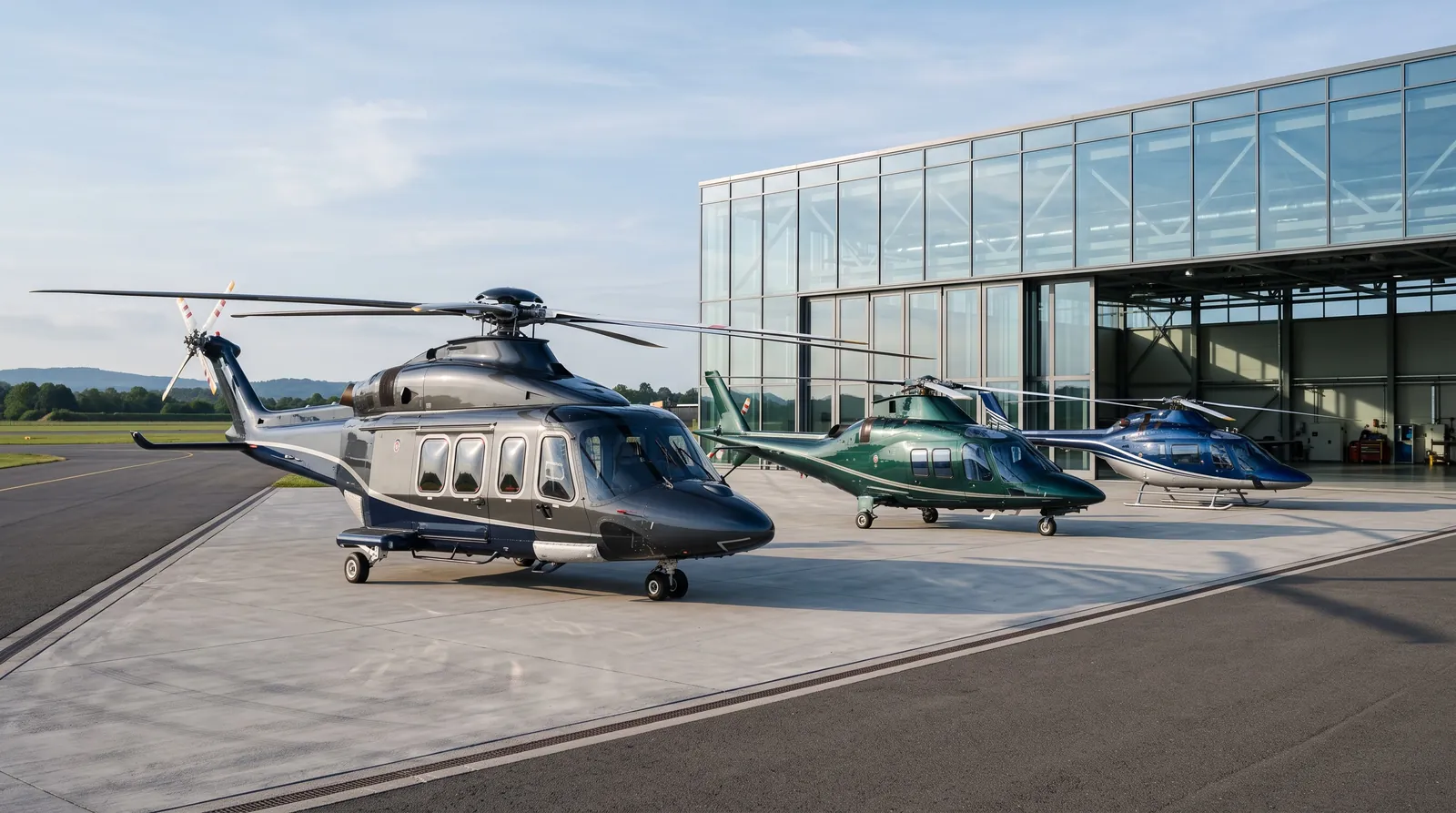
The VIP and corporate helicopter field is dominated by three manufacturers. Airbus Helicopters sells its corporate versions under the ACH label, Leonardo offers the AW family from the light AW109 Trekker to the large AW139, and Bell is represented here by the single-engine Bell 505. The machines fall into three steps: light singles for short daylight hops, light twins for city and coastal work, and medium twins that carry more passengers further, in more weather, with something close to a small jet's comfort.
The field at a glance
| Model | Engines | Passengers | Max cruise | Max range |
|---|---|---|---|---|
| Bell 505 | 1, Safran Arrius 2R | 4 | 125 kt | 306 nm (sea level, no reserve) |
| Airbus ACH130 | 1, Safran Arriel 2D | up to 6 | 130 kt | 347 nm |
| Leonardo AW109 Trekker | 2, Pratt & Whitney Canada PW207C | up to 6 | 148 kt | 447 nm (auxiliary tanks, no reserve) |
| Airbus ACH145 | 2, Safran Arriel 2E | up to 8 | 137 kt | 366 nm |
| Leonardo AW169 | 2, Pratt & Whitney Canada PW210A1 | up to 10 | 144 kt | 424 nm |
| Airbus ACH160 | 2, Safran Arrano 1A | up to 10 | 155 kt | 460 nm |
| Leonardo AW139 | 2, Pratt & Whitney Canada PT6C-67C | up to 15 | 165 kt | 641 nm (auxiliary tank, no reserve) |
Two cautions. Airbus quotes slightly different figures for the standard civil versions, the H130, H145 and H160, which are measured at different speeds and conditions from the corporate ACH figures in the table. And maximum range figures assume ideal conditions; with full seats, reserves and a real route, the practical range of any of these machines is well below the brochure.
The light singles: ACH130 and Bell 505
The ACH130 is the corporate version of the H130, known for its wide cabin, large windows and the forward-facing seating that makes it a favourite for scenic and short transfer work. A single Arriel 2D powers it, and Airbus quotes up to six passengers in the ACH layout. The Bell 505 is smaller, with a pilot and four passengers, a Garmin G1000H glass flight deck and a single Arrius 2R engine. Both are economical, quick to turn round and well suited to daylight hops over open country or water. As singles, they are restricted in commercial service to daylight and good weather, and kept away from congested hostile areas, as explained in Single or Twin Engine.
The light twins: AW109 Trekker and ACH145
The AW109 Trekker is the skid-equipped member of Leonardo's AW109 line, powered by two PW207C engines and quick for its size, with a published maximum cruise of 148 knots. It seats up to six passengers and is often chosen where speed and a twin's flexibility matter more than cabin volume. The ACH145 is larger inside, with up to eight passengers, a Fenestron shrouded tail rotor and Airbus's Helionix flight deck. It is a common choice for city and estate work, where cabin space and the reassurance of two engines carry equal weight.
The medium twins: AW169 and ACH160
The AW169 sits between the light twins and the AW139, with up to ten passengers, two PW210A1 engines and a maximum cruise of 144 knots. Leonardo stresses the size of its cabin for the class. The ACH160 is the corporate version of the Airbus H160, also seating up to ten in the corporate layout, with two Arrano 1A engines, a maximum cruise of 155 knots and Blue Edge main rotor blades shaped to reduce noise. Both are modern designs aimed squarely at operators who want a quiet, smooth, instrument-capable machine for regular corporate flying.
The large cabin: AW139
The AW139 is the largest machine in this comparison, with up to 15 passengers in utility seating, two PT6C-67C engines and the highest published cruise speed here, 165 knots. In VIP configuration the cabin is typically fitted with far fewer, larger seats. It is widely used by governments, heads of state and corporate fleets, and suits longer legs, larger groups and missions where range and speed matter more than the size of the landing site.
Choosing between them
The right machine follows the mission. For a short daylight hop over the sea, a light single is efficient and pleasant. For a city heliport, night flights or regular corporate use, a twin is usually required by the rules and preferred by passengers. For long legs and big groups, the medium twins and the AW139 come into their own. Costs rise accordingly, as set out in Helicopter Transfers: When the Rotor Beats the Road. When chartering, ask the operator which type will fly, how many seats it will actually offer with your baggage, and whether the flight is planned in performance class 1. The checks that apply to any operator are in Choosing a Charter Operator.
Questions
What is the best helicopter for VIP transport?
There is no single answer, because the mission decides. Light singles such as the ACH130 or Bell 505 suit short daylight hops, light twins such as the AW109 Trekker and ACH145 suit city and coastal work, and medium twins such as the AW169, ACH160 and AW139 suit longer legs, larger groups and flights in more weather.
How many passengers does a VIP helicopter carry?
Published maximums range from four passengers in a Bell 505 to up to 15 in a Leonardo AW139 in utility seating. VIP cabins are usually fitted with fewer, larger seats, and the real number on a given day depends on baggage, fuel and the conditions at the landing site.
How fast do corporate helicopters fly?
The machines in this comparison have published maximum cruise speeds between 125 knots for the Bell 505 and 165 knots for the AW139. Real block speeds are lower once climb, descent and routing are included.
Figures checked 19 October 2026. Prices are indicative and never a quote. Seen something out of date? Tell the editors.