
APTAirports · Profile
Nice Cote d'Azur: Summer Peaks on the Riviera
Nice handles more business jets than any European airport except Le Bourget. How slots, summer apron pressure, night rules and the hop to Monaco or Saint-Tropez shape a Riviera trip.
3 min readRolavia editors
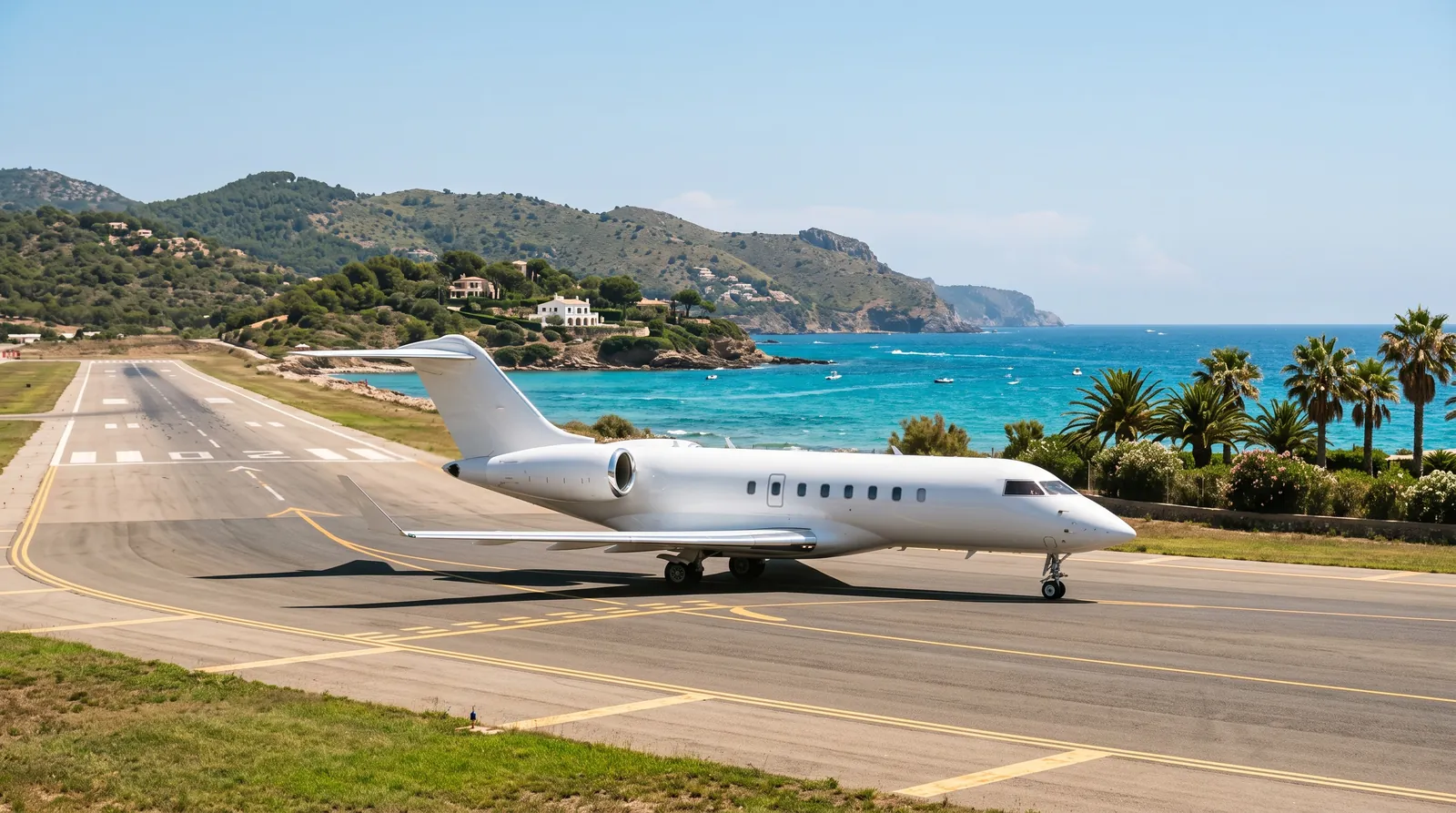
Nice Côte d'Azur is the Riviera's main airport and, in recent European Business Aviation Association figures, the second busiest business aviation airport in Europe after Paris Le Bourget. It sits on land reclaimed from the sea at the mouth of the Var, 3.2 nm (about 6 km) from the centre of Nice, with two parallel runways along the shore. Business flights share it with a large airline operation, which is why slots, apron space and timing matter more here than at a dedicated business airport.
A business terminal inside an airline airport
Nice has a dedicated business aviation terminal, separate from the airline terminals, and several handling companies. Passengers arrive at a small building, complete formalities there and leave by car or helicopter. The aircraft, however, use the same runways and taxiways as the airlines. The airport's operator, Aéroports de la Côte d'Azur, also runs Cannes-Mandelieu and Saint-Tropez La Môle, the two smaller airfields that complete the Riviera picture.
Nice also has its own helicopter station on the airport, so a jet-to-helicopter connection does not involve a road transfer. Tell the operator early if you want one, how many passengers and bags will make the onward leg, and whether a car should follow with the heavier luggage.
Slots for every movement
Nice is a coordinated airport under European slot rules. The French AIP requires a slot from COHOR, the French slot coordinator, for every landing and take-off, and business and general aviation flights must quote the COHOR reference in their flight plan. The operator handles this, but it has consequences for passengers. In peak weeks, the time you ask for may not be the time you get, and a change of plan on the day means a new slot request rather than simply leaving earlier. Keep some flexibility around anything that depends on a precise time, such as a dinner in Monaco or a yacht tender waiting at the quay.
Summer: the apron is the bottleneck
From late spring to early autumn, and above all around the Cannes Film Festival and the Monaco Grand Prix in May and the peak weeks of July and August, parking space for business jets is the scarce resource. When the apron fills, operators often drop the passengers, reposition the aircraft to another airport and bring it back for the return, which adds two positioning legs to the bill.
Ask at the quote stage whether parking is confirmed for the full stay and what happens if it is not. FBO fees decoded explains how parking and handling are charged, and the charter cost estimator gives an idea of what an extra positioning flight adds.
Night rules
Air traffic services, customs and police work around the clock at Nice. The night restrictions target the noisiest aircraft: Chapter 2 types and the noisiest Chapter 3 aircraft may not take off between 23:15 and 06:00 or land between 23:30 and 06:15 local time. Modern business jets are not in those categories, but late departures still depend on slots and stand availability, so a late return needs to be planned rather than assumed.
Onward to Monaco, Cannes and Saint-Tropez
- Monaco: the helicopter transfer from Nice to the Monaco heliport is one of the shortest regular hops in Europe; Nice to Monaco by helicopter has the details. The coast road is the alternative, with traffic deciding the time.
- Cannes: Cannes-Mandelieu, 3.2 nm west of Cannes, has a 1,540 m runway and admits jets of up to 35 tonnes maximum take-off weight. It is closed at night, but it puts light and midsize jets very close to the Croisette.
- Saint-Tropez: La Môle, about 15 km south-west of the town, has a 1,071 m runway and restricted-use status with prior permission, so only suitable aircraft and trained crews go there. For larger jets the usual answer is Nice followed by a helicopter or a long drive.
The Helicopter or Car tool compares door-to-door times for the classic Riviera transfers in both directions.
Questions
Do private jets need a slot at Nice airport?
Yes. Nice is a coordinated airport, and the French AIP requires a COHOR slot for every landing and take-off, business and general aviation included. The operator requests it, but changes on the day mean a new slot request.
How do you get from Nice airport to Monaco?
Either by helicopter to the Monaco heliport, a very short flight, or by car along the coast. The road takes longer and depends heavily on traffic, especially during big events in May and in high summer.
Can business jets fly in and out of Nice at night?
Yes. Air traffic services, customs and police work around the clock, and the night bans apply to the noisiest aircraft types rather than to modern business jets. Slots and stand availability still decide whether a late movement works.
Is Cannes-Mandelieu an alternative to Nice?
For smaller jets, yes. Cannes-Mandelieu has a 1,540 m runway, accepts jets of up to 35 tonnes maximum take-off weight and is closed at night. Larger aircraft use Nice.
Figures checked 19 October 2026. Prices are indicative and never a quote. Seen something out of date? Tell the editors.