
APTAirports · Profile
London Biggin Hill: The Business Airport South of the City
Biggin Hill is London's business airport on the edge of Kent: one 1,806 m runway, no airlines, fixed opening hours and a drive into town that depends on the traffic.
4 min readRolavia editors
London Biggin Hill is a business and private aviation airport 12 nm (about 22 km) south-south-east of central London, on the high ground where Greater London meets Kent. It has one runway of 1,806 m, no airline traffic and fixed opening hours. That makes it calm and quick to use, and less forgiving of a late schedule than the capital's round-the-clock airports.
From fighter station to business airport
Biggin Hill made its name as an RAF fighter station in the Battle of Britain, and the memorial chapel beside the airfield still recalls that period. Today the airport is run by a private company on a long lease from the London Borough of Bromley. A Court of Appeal ruling in 2001 confirmed that the operator may not sell tickets for flights, which keeps scheduled airlines out. What remains is a field built around business jets, private owners, flying schools and maintenance, including a large Bombardier service centre.
For passengers that means a small terminal, short walks and no airline queues. For operators it means a single runway and opening hours set in agreement with the borough, both of which shape when a trip can start and finish.
The runway, and the numbers crews actually use
The single runway, 03/21, is 1,806 m long and 45 m wide according to the UK AIP. The figures that matter for planning are the declared distances, which are shorter. The take-off run available is 1,781 m on runway 03 and 1,670 m on runway 21. The landing distance available is 1,555 m on runway 03 and 1,670 m on runway 21. Those distances are comfortable for light, midsize and super-midsize jets, and large-cabin aircraft use the field regularly.
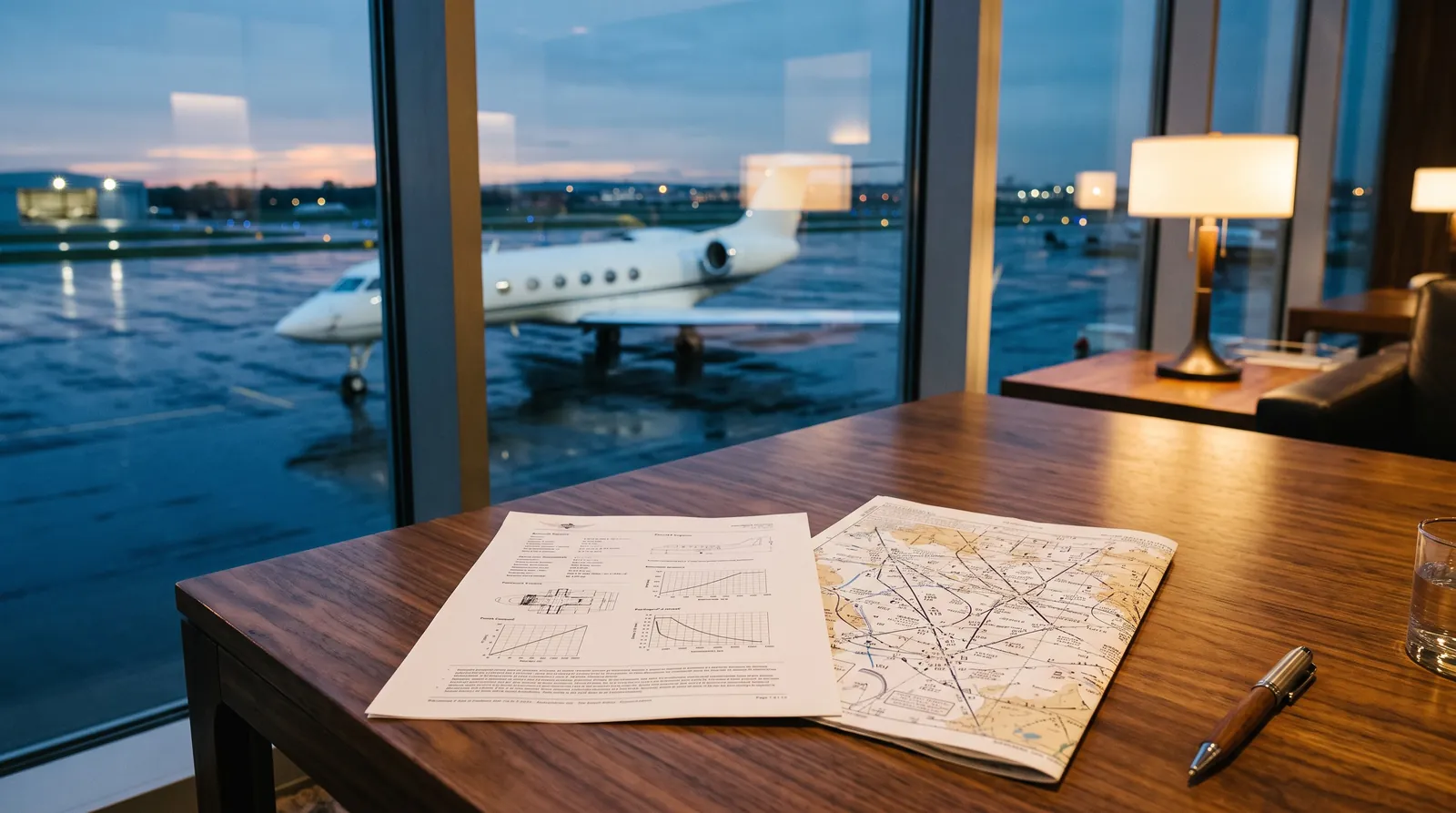
The tighter question is weight. A long-range jet leaving with full fuel on a warm day needs far more runway than the same aircraft leaving for Geneva or Nice. Crews work this out from the aircraft's performance charts, and on the longest missions the answer can be a reduced fuel load, a technical stop or a departure from a longer runway elsewhere. The take-off field length on a brochure is only a starting point; the guide to reading an aircraft spec sheet explains why.
Opening hours shape the day
Biggin Hill is not a 24-hour airport. It opens at 06:30 and closes at 23:00 on weekdays, and runs from 08:00 to 22:00 at weekends and on public holidays. For an evening return from southern Europe, the closing time is the line to plan around. A late slot at the departure end, a de-icing queue or a strong headwind can push the arrival past closing, and the flight then has to divert to another London airport with longer hours, with the car rerouted to meet it.
Early weekend departures meet the same constraint at the other end of the day: nothing leaves before 08:00 on a Saturday or Sunday. A sensible habit is to build a margin into the planned arrival time and to ask the operator in advance which alternate it would use if the evening runs late.
Getting into London
Biggin Hill suits homes and offices in Kent, Surrey and south and east London particularly well. The drive into central London crosses the south-eastern suburbs, and the time it takes depends far more on the hour of the day than on the distance, so a mid-morning arrival is a very different proposition from a Friday evening one. Ask the handler beforehand how cars are brought to the terminal or the aircraft, and send the driver's details early. The FBO arrival checklist covers what to arrange before the day.
What Biggin Hill suits, and what it does not
- Well suited: European trips in light to large-cabin jets, quick turnarounds, and passengers who value a small terminal and short distances on foot.
- Worth a second look: late-evening arrivals close to closing time, full-fuel long-range departures, and any plan that falls in the hours when the airport is shut.
- Alternatives: Farnborough to the south-west, Luton and Stansted to the north, and London City for smaller, specially approved jets close to the centre, each with its own hours and costs.
To see how a London departure prices by cabin class, the charter cost estimator gives an indicative band, and what an FBO does explains the handling side of the bill.
Questions
How far is Biggin Hill Airport from central London?
The UK AIP places Biggin Hill 12 nm, about 22 km, south-south-east of London. By road the journey crosses the south-eastern suburbs, so the time depends far more on traffic than on distance. Plan the car around the time of day.
What are Biggin Hill's opening hours?
The airport is open from 06:30 to 23:00 local time Monday to Friday, and from 08:00 to 22:00 on Saturdays, Sundays and public holidays. It is not a 24-hour airport, so a late arrival needs a time margin or an agreed alternate.
Can large business jets use Biggin Hill?
Yes. The 1,806 m runway takes large-cabin jets regularly. On the longest missions at high weight, crews check the declared distances, which are shorter than the physical runway, and may plan a lighter fuel load or a technical stop.
Are there airline flights from Biggin Hill?
No. A 2001 court ruling confirmed that the operator may not sell tickets for flights, so there are no scheduled airlines. The traffic is business aviation, private flying, training and maintenance.
Figures checked 19 October 2026. Prices are indicative and never a quote. Seen something out of date? Tell the editors.