
APTAirports · Profile
Courchevel Altiport: The Steep Runway Above the Pistes
Courchevel's altiport has a 536 m runway that slopes at up to 18.66 per cent, no jets and a mountain qualification for every aeroplane pilot. How it works and how jet travellers connect.
3 min readRolavia editors
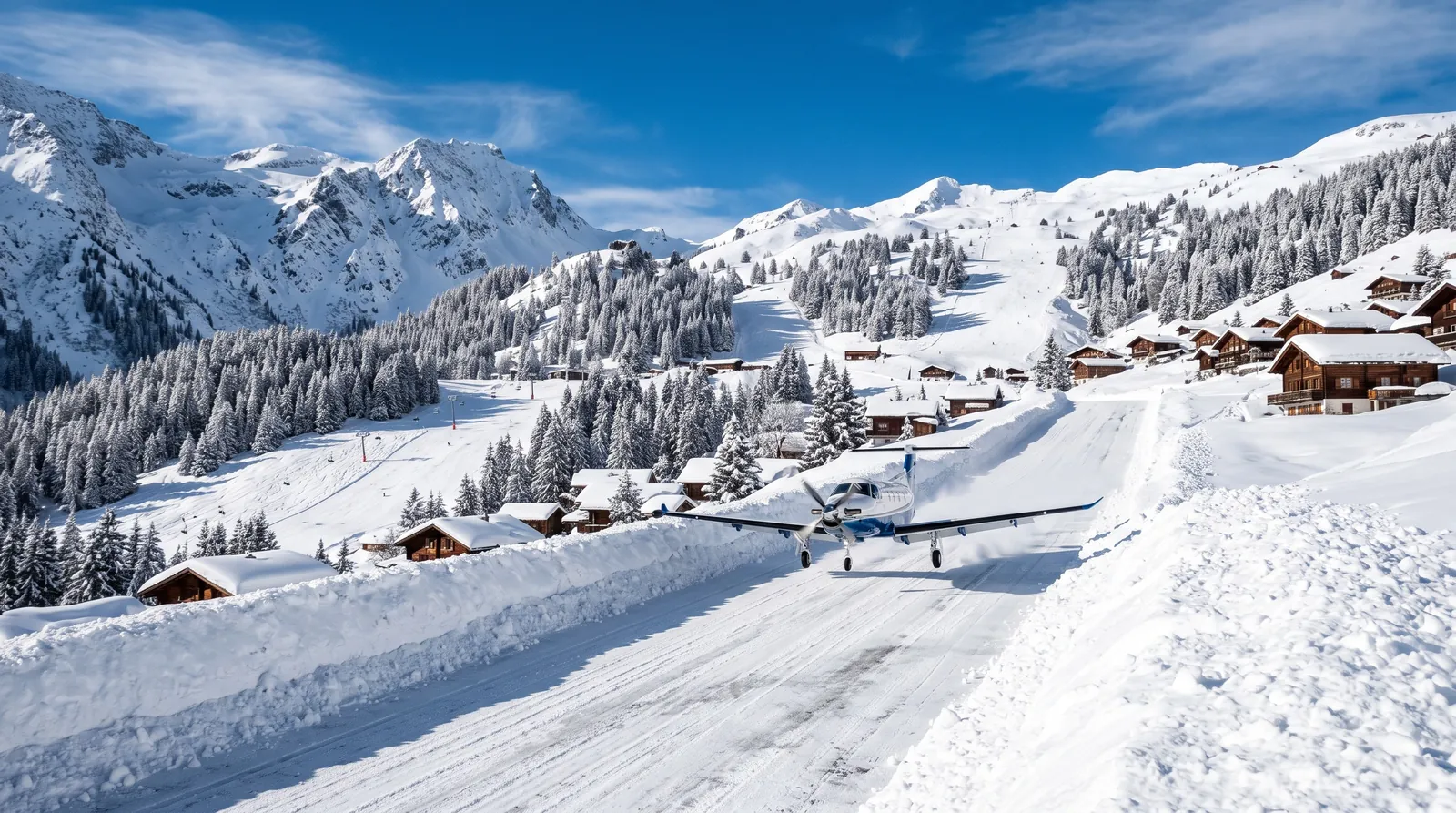
Courchevel altiport is a 536 m strip on the mountainside above the resort, at about 6,580 ft, with a runway that climbs steeply from one end to the other. It is open only to propeller aeroplanes of up to 5.7 tonnes and to helicopters, every aeroplane pilot needs a mountain qualification or a specific authorisation, and all flying is visual and by day. Jet travellers land elsewhere, usually at Chambéry or Geneva, and finish the journey by helicopter, turboprop or car.
A runway built into the slope
The runway profile in the French AIP explains the altiport's reputation. Over 536 m the surface drops about 65 m (212 ft). The upper section next to the parking area is almost flat, the steepest section slopes at 18.66 per cent over 280 m and the lower section at 12.5 per cent. Aeroplanes always land uphill on runway 22, so the slope helps them stop, and always take off downhill on runway 04, so it helps them accelerate. The terrain leaves little room for a late change of mind on final approach, which is why the arrival is flown with great precision and why the qualification matters.
Who may land: the qualification
The AIP is specific. Aeroplane pilots must hold the mountain rating for wheeled aircraft, the qualification montagne roue, or a valid authorisation to use the altiport, obtained through site-specific training. Single-engine aeroplanes above 2.5 tonnes and all twin-engine aeroplanes also need a file lodged with the regional civil aviation authority, DSAC Centre-Est, covering the pilot, the operating limitations, the take-off and landing procedures and what to do after an engine failure on take-off.
Commercial passenger flights in aeroplanes need, in addition, the approvals from the operator's own authority and a specific authorisation from DSAC Centre-Est for each aircraft type. Training organisations offer altiport courses on single-engine turboprops such as the Pilatus PC-12 and the Daher TBM family, with ground school on sloping runway performance and landings at Courchevel itself.
Which aircraft can use it
- Allowed: propeller aeroplanes with a maximum take-off weight of up to 5.7 tonnes, mostly piston aircraft and light turboprops, subject to the pilot and file requirements above. Helicopters may use the altiport without restriction.
- Not allowed: jets of any size. Even a jet designed for short and rough strips, such as the Pilatus PC-24, falls outside the rule.
- Practical limits: there is no jet fuel for aeroplanes, only for helicopters, and night flying is not approved.
Customs, winter and the arrival
Customs rules decide where a flight can come from. Flights from Schengen countries outside the European Union, Switzerland for example, need customs on request with 24 hours' notice, and flights from outside the Schengen area are not authorised at all. A turboprop shuttle from Geneva is therefore possible with notice, while a passenger arriving from London must first enter the Schengen area at an airport such as Geneva or Chambéry.
In winter an AFIS information service runs on published hours, the aprons are allocated by length of stay, and a free shuttle links the altiport with Courchevel 1850. The AIP lists high snowbanks along the runway edges, low winter sun on the final approach to runway 22 and heavy paragliding activity among its hazards. Weather decides more trips than any rule.
How jet travellers connect
For a private jet, the realistic choices are Chambéry, usually the closest option, Geneva or Lyon. From there, the last leg is a helicopter to the altiport, a car up the valley or, less often, a turboprop flight into the altiport itself. The helicopter is fastest when the weather allows; the car is the plan that always works.
Courchevel by private jet compares the airports and the winter Saturday traffic, and Alpine helicopter transfers covers the rotor leg in detail. The charter cost estimator gives an indicative price for the jet leg into Chambéry or Geneva.
Questions
Can a private jet land at Courchevel?
No. The altiport is reserved for propeller aeroplanes of up to 5.7 tonnes maximum take-off weight and for helicopters. Private jets land at Chambéry, Geneva or Lyon, and passengers continue by helicopter, turboprop or car.
How long and steep is the Courchevel runway?
The runway is 536 m long and 40 m wide, and its steepest section slopes at 18.66 per cent. Aeroplanes land uphill on runway 22 and take off downhill on runway 04, with the top of the runway at 6,583 ft.
What qualification do pilots need to land at Courchevel?
Aeroplane pilots need the French mountain rating for wheeled aircraft or a valid authorisation for the altiport. Heavier single-engine and all twin-engine aeroplanes need a file with DSAC Centre-Est, and commercial flights need a type-specific authorisation.
Can you fly directly to Courchevel altiport from London?
No. Flights from outside the Schengen area are not authorised at the altiport. Travellers from London first land at a Schengen airport such as Geneva or Chambéry and continue from there.
Figures checked 19 October 2026. Prices are indicative and never a quote. Seen something out of date? Tell the editors.