
ACFAircraft · Profile
Pilatus PC-24: The Jet for Short and Rough Runways
A business jet approved for unpaved strips, with a standard cargo door and 2,000 nm of range: what the Pilatus PC-24 can reach, and what it still cannot.
4 min readRolavia editors
The PC-24 was designed to do what most business jets cannot: operate from short runways, including unpaved ones. Pilatus quotes a takeoff distance of 3,090 ft (940 m) over a 50 ft obstacle, the aircraft is approved for operations from grass, gravel and other unmade strips, and a large cargo door in the rear fuselage is standard. With 2,000 nm of range and six passengers, it is a jet that opens airfields rather than airports.
Short and rough
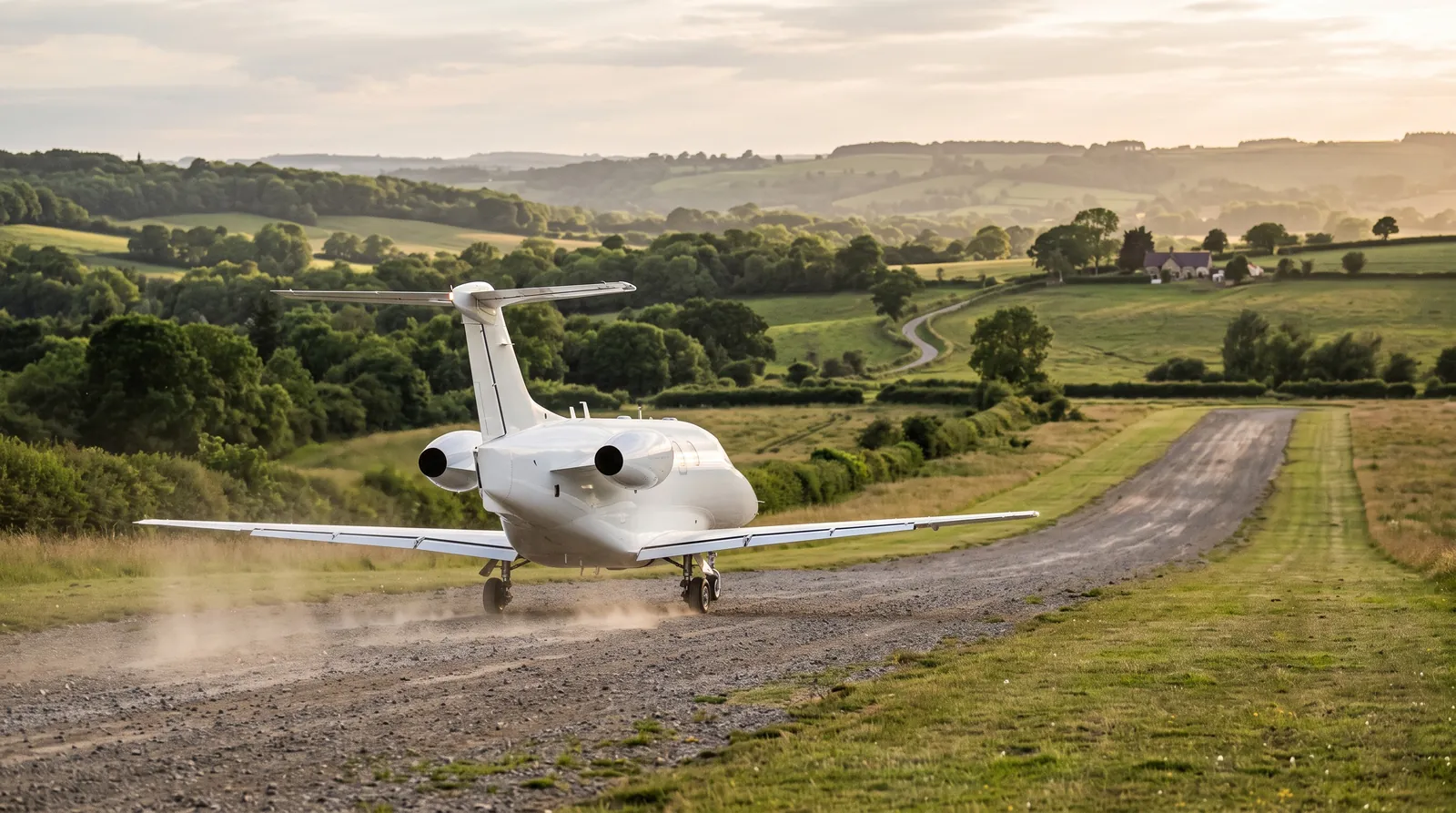
Most jets need long, paved runways: they approach fast, and stones thrown up by the wheels can damage engines, flaps and the underside. The PC-24 has a low stall speed of 83 kt, a landing distance of 2,410 ft (735 m) over a 50 ft obstacle and engines placed high on the rear fuselage. After certification in December 2017, Pilatus tested it on grass and gravel, and EASA and the FAA approved unpaved runway operations in 2019. The manufacturer lists grass, gravel, earth and snow among the surfaces it can use.
Approval of the aircraft is only part of the answer. Each strip still needs to be long enough for the day's weight and temperature, firm after rain and known to the crew, and every operator decides for itself whether and how it uses unpaved airfields. If a trip depends on a particular strip, raise it at the first enquiry. Airport rules matter too: some well-known short runways restrict which aircraft types may use them, whatever their field performance, so the airport's own conditions are the final word.
Cargo door and cabin
The cargo door measures 4 ft 1 in wide and 4 ft 3 in high (1.25 m by 1.30 m), standard on every aircraft. It loads bicycles, surfboards, hunting gear, equipment cases or a stretcher, which is why the PC-24 also flies as an air ambulance. Behind the cabin, the baggage area offers 90 cu ft (2.5 m³), heated, pressurised and reachable in flight.
The cabin runs 23 ft 0 in (7.01 m) from the cockpit partition to the aft pressure bulkhead, is 5 ft 7 in (1.69 m) wide and 5 ft 1 in (1.55 m) high over a continuous flat floor, with a volume of 498 cu ft (14.1 m³). Layouts range from a six-seat executive cabin through double club and divan versions with eight seats to a ten-seat commuter interior, and a divan can convert into a bed.
Range, speed and cockpit
Maximum cruise speed is 440 kt and the ceiling 45,000 ft. Pilatus quotes 2,000 nm with six passengers and 2,040 nm with four, based on NBAA IFR reserves with a 100 nm alternate, 200 lb per passenger, cruise at 45,000 ft and no wind. Two Williams FJ44-4A QPM engines deliver 3,420 lb of normal takeoff thrust each. The right engine has a quiet power mode that runs it at low power on the ground in place of an auxiliary power unit, so the cabin can be cooled or heated on a remote strip without ground equipment. The flight deck is certified for single-pilot operation.
| Item | Figure |
|---|---|
| Range | 2,000 nm (3,704 km) with 6 passengers; 2,040 nm (3,778 km) with 4; NBAA IFR reserves, 100 nm alternate, no wind |
| Maximum cruise speed | 440 kt (815 km/h) |
| Passengers | 6 to 8 in executive layouts, up to 10 in commuter layout |
| Cabin length | 23 ft 0 in (7.01 m), cockpit partition to aft pressure bulkhead |
| Cabin height | 5 ft 1 in (1.55 m), flat floor |
| Cabin width | 5 ft 7 in (1.69 m) |
| Baggage volume | 90 cu ft (2.5 m³) |
| Cargo door | 4 ft 1 in wide, 4 ft 3 in high (1.25 m by 1.30 m) |
| Takeoff distance | 3,090 ft (940 m) over a 50 ft obstacle |
| Landing distance | 2,410 ft (735 m) over a 50 ft obstacle |
| Maximum altitude | 45,000 ft |
| Engines | Two Williams FJ44-4A QPM, 3,420 lb normal takeoff thrust each |
| Entry into service | February 2018, after type certification in December 2017 |
Missions to small airfields
The PC-24 earns its keep where the nearest long runway is far from the destination:
- Country estates, ranches and vineyards with their own grass or gravel strips.
- Island and coastal airfields whose runways are too short for most jets.
- Valley airfields that bring a mountain resort within a short drive instead of a long transfer.
- Medical flights, where the cargo door and a short-field landing save time on both ends.
Its range of 2,000 nm still allows long legs between such places: Geneva to Athens is about 935 nm, London to Mykonos about 1,390 nm. The trade-off is speed and cabin height. A Phenom 300E cruises faster on paved runways, and the HondaJet Elite II is smaller and less costly. Where the runway is short or soft, neither replaces the PC-24. Its spec sheet rewards a careful reading, because its takeoff figure is quoted over an obstacle rather than as a field length; how to read a spec sheet explains the difference, and the Aircraft Finder lets you filter by runway length.
Questions
Can the Pilatus PC-24 land on grass or gravel?
Yes. After certification in 2017 the PC-24 was approved by EASA and the FAA for operations from unpaved runways in 2019, and Pilatus lists grass, gravel, earth and snow among suitable surfaces. Each strip and each operator still needs its own assessment.
How big is the PC-24 cargo door?
The standard cargo door is 4 ft 1 in wide and 4 ft 3 in high (1.25 m by 1.30 m). It allows bulky items such as bicycles, sports equipment or a stretcher to be loaded directly.
How far can the PC-24 fly?
Pilatus quotes 2,000 nm with six passengers and 2,040 nm with four, using NBAA IFR reserves with a 100 nm alternate, 200 lb per passenger and no wind. Maximum cruise speed is 440 kt.
How much runway does a PC-24 need?
Pilatus quotes a takeoff distance of 3,090 ft (940 m) and a landing distance of 2,410 ft (735 m), each measured over a 50 ft obstacle. Weight, temperature, elevation and surface condition all change the real requirement.
Figures checked 19 October 2026. Prices are indicative and never a quote. Seen something out of date? Tell the editors.