
ACFAircraft · Guide
Range, Runway, Cabin: How to Read an Aircraft Spec Sheet
Brochure range, takeoff distance and cabin size are all measured on a good day. What each line of a business jet spec sheet assumes, and the questions that get you the real number.
5 min readRolavia editors
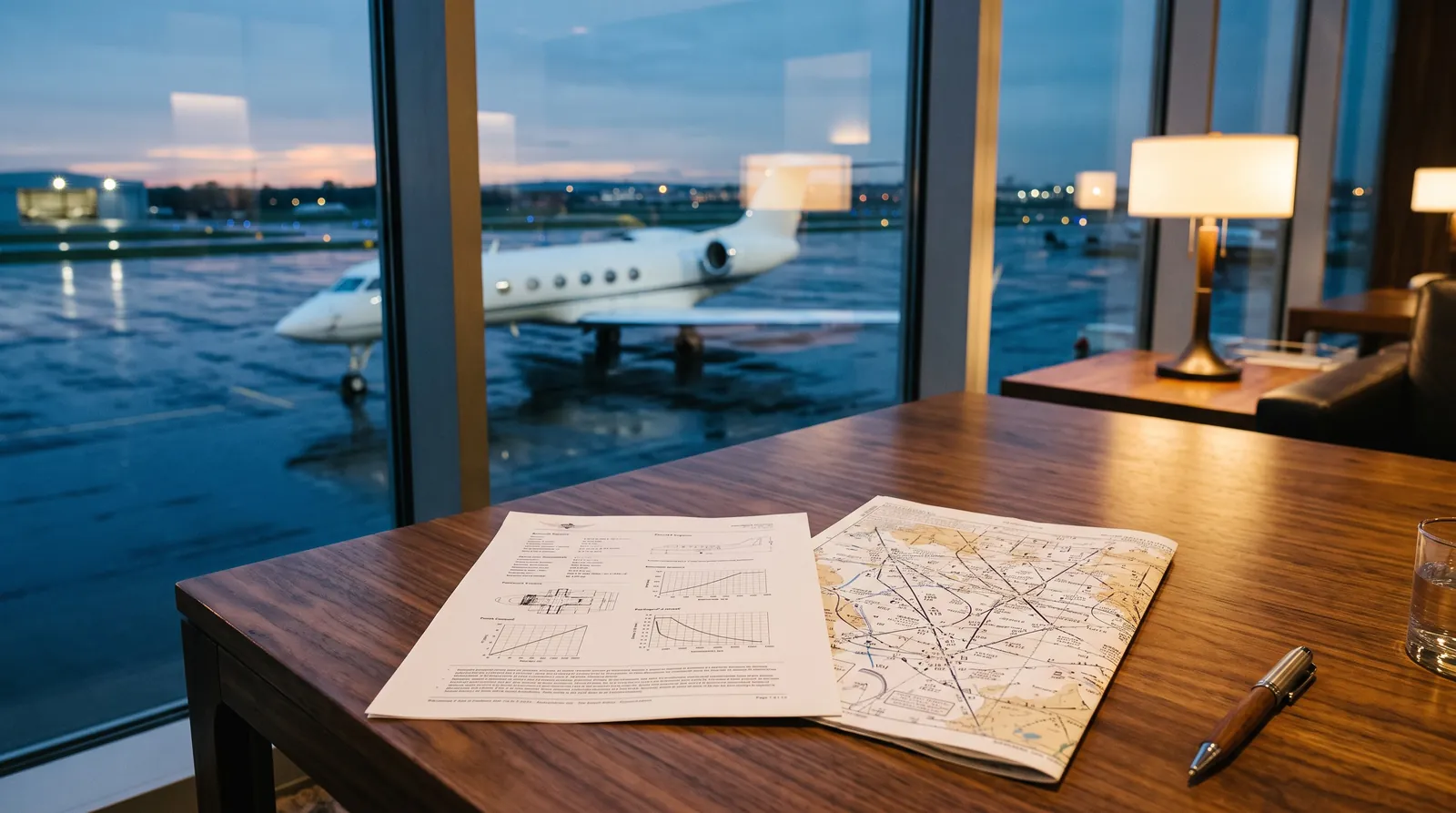
A spec sheet answers three questions: how far the aircraft flies, how much runway it needs and how much room you get inside. Every number is true, and every one is measured on a good day: range with a light load in still air, runway at a cool sea-level airport, cabin at its most generous point. Read the footnotes and a brochure becomes a planning tool rather than a promise.
Range: always ask "with what"
Headline range is the distance covered with a stated payload, at a stated speed, arriving with a defined fuel reserve. Change any one and the number moves.
- Payload. The manufacturer chooses the passenger count. Gulfstream quotes the G700 at 7,750 nm with eight passengers and four crew; Bombardier quotes the Challenger 3500 at 3,400 nm with four passengers. Embraer and Pilatus count each occupant at 200 lb (91 kg).
- Speed. Range is usually quoted at economical cruise. Fly faster and it shrinks: the G700 is quoted at 7,750 nm at Mach 0.85 but 6,650 nm at Mach 0.90.
- Reserves. "NBAA IFR reserves" is the business aviation convention: fuel on arrival for a missed approach, a short hold, a diversion to an alternate airport and a final reserve. Some footnotes assume a 200 nm alternate, others 100 nm, and that alone shifts the figure.
- Weather. Most brochure range assumes still air and standard temperatures. A few footnotes are stricter: Embraer uses 85 per cent annual winds for the Phenom 300E, Bombardier a takeoff at ISA plus 15°C for the Challenger 3500.
Treat published range as a ceiling. A real trip adds airways routing, headwinds (strongest westbound over the North Atlantic in winter), a fully outfitted cabin and more luggage than a footnote passenger carries. A route right at the edge usually means a fuel stop on some days. The Range Check tool shows nonstop reach from a given airport; read results near the limit with that in mind.
Runway: field length, not runway length
Takeoff distance is normally given at maximum weight, at sea level, in ISA conditions (15°C) on a dry paved runway. For larger jets certified under transport category rules it is a field length: the runway needed to stop after an engine failure at the decision speed, or to continue and reach 35 ft on the remaining engine, whichever is longer, and never less than 115 per cent of the all-engine distance. Smaller jets often quote the distance to clear a 50 ft obstacle, as Pilatus does for the PC-24.
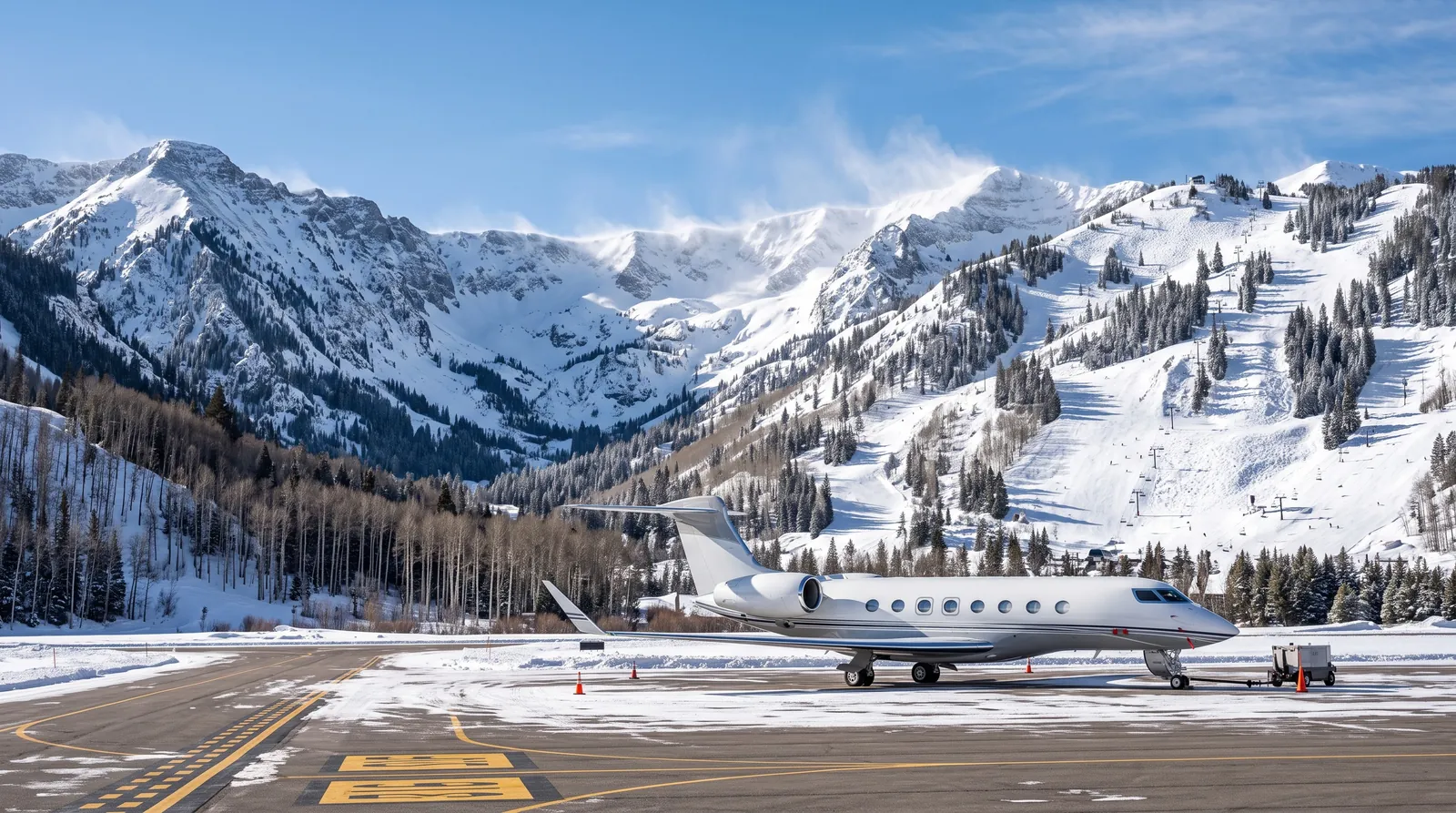
Three things change the real figure. Heat and elevation thin the air, so a summer afternoon at a mountain airport such as Aspen needs far more runway than the brochure suggests. Weight works the other way: on a short hop with part tanks, a long-range jet uses much less runway. Wet or contaminated surfaces add distance again.
Landing figures are usually unfactored, meaning measured by test pilots in ideal conditions. Commercial operators must plan with regulatory safety factors on top, so the runway a charter flight actually needs is considerably longer than the brochure landing distance, and longer again when the runway is wet.
Cabin: three dimensions, three caveats
Height is usually given at the centre line; in cabins with a dropped aisle, headroom shrinks once you step sideways. Width is the maximum across the cabin, and the floor is narrower. Length needs the most care. Bombardier measures from the cockpit divider to the aft end of the cabin, excluding baggage; Gulfstream quotes the G700 at 56 ft 11 in excluding baggage and 63 ft 8 in as total interior length. Compare like with like.
Six feet is the line most people care about. In a cabin of about 1.83 m, most adults stand upright: the Citation Latitude and Challenger 3500 both reach it. Light jets such as the Phenom 300E sit just under 5 ft.
Baggage and cabin altitude
Baggage volume comes in cubic feet. Ask whether the figure is internal (reachable in flight), external, or a total. The Citation Latitude lists 127 cu ft in all, up to 100 cu ft of it in the external hold; the Phenom 300E lists 84 cu ft of total stowage, 66 cu ft of it in the rear compartment. Skis and golf bags pack differently from hard cases, so give the operator a list rather than a number.
Cabin altitude is the pressure you breathe. Transport category certification caps it at 8,000 ft in normal operation, and newer large jets do far better. A quoted figure needs its reference level: the G700 holds 2,840 ft at 41,000 ft and the Global 8000 2,691 ft at the same level, while the Phenom 300E quotes a maximum of 6,600 ft. The cabin altitude article explains why it matters.
What to ask before you trust a number
| Line | What it usually assumes | What to ask |
|---|---|---|
| Range | Stated passengers at about 200 lb, economical cruise, still air, NBAA IFR reserves | Can it fly my route with my load in winter winds? |
| Takeoff distance | Maximum weight, sea level, 15°C, dry runway | What does it need at my airport's elevation on a hot day? |
| Landing distance | Unfactored, typical landing weight | What is the factored requirement for a commercial flight, wet or dry? |
| Cabin length | Excluding cockpit, sometimes excluding baggage | Measured from where, and how much is galley and lavatory? |
| Baggage | Total of internal and external volume | How much is reachable in flight, and do my hard cases fit? |
| Cabin altitude | At a stated cruise level | At which level, and at the aircraft's ceiling? |
None of this makes brochures dishonest: the figures are measured to recognised standards and footnoted, and simply describe the aircraft at its best. Start from the trip instead: the Aircraft Finder takes passengers, distance and runway and works backwards. For the classes these numbers define, see the private jet categories explained; the Gulfstream G700 profile puts every line of a sheet in context.
Questions
What does NBAA IFR range mean?
It is a range calculated with the fuel reserves recommended by the National Business Aviation Association: enough fuel on arrival for a missed approach, a hold, a diversion to an alternate airport and a final reserve. It makes brochures easier to compare, but each manufacturer still chooses the passenger count, speed and alternate distance in the footnote.
Why can a jet not always fly its brochure range?
Brochure range assumes a stated light payload, still air, standard temperatures and an economical cruise speed. Real trips add airways routing, headwinds, a fully furnished cabin, more baggage and sometimes a faster cruise, all of which cut the distance. Routes near the published limit often need a fuel stop on some days of the year.
What cabin height do you need to stand up in a private jet?
Around 6 ft (1.83 m) lets most adults stand upright. Midsize and super midsize jets such as the Citation Latitude and Challenger 3500 reach that height, large jets such as the G700 go higher, and light jets usually stay just under 5 ft.
Is the published takeoff distance the runway length a jet needs?
Only under the stated conditions, usually maximum weight, sea level and 15°C on a dry runway. Hot weather, high elevation and wet surfaces lengthen it, while a lighter aircraft on a short sector needs less. For landing, commercial rules add a safety factor to the unfactored brochure figure.
Figures checked 19 October 2026. Prices are indicative and never a quote. Seen something out of date? Tell the editors.