
PJTPrivate Jets · Background
Private Jets and Emissions: SAF, Offsets and Honest Numbers
How much CO2 a private jet emits per hour by class, what sustainable aviation fuel really changes, what the EU mandate requires, and where offsets and book and claim fall short.
5 min readRolavia editors
A private jet burns roughly 250 kg of fuel an hour at the small end of the market and more than 1,500 kg at the large end, and every kilogram burned releases about 3.16 kg of CO2. Per passenger, that is many times the figure for a seat on a full airliner on the same route. Sustainable aviation fuel can cut part of the lifecycle emissions and offsets can compensate for some of the rest, but neither makes a flight emission free.
Fuel burn and CO2 per hour by class
| Class | Fuel per hour (kg) | CO2 per hour (tonnes) |
|---|---|---|
| Very light jet | 250 to 350 | 0.8 to 1.1 |
| Light jet | 400 to 600 | 1.3 to 1.9 |
| Midsize jet | 600 to 800 | 1.9 to 2.5 |
| Super midsize jet | 750 to 1,000 | 2.4 to 3.2 |
| Large cabin jet | 1,000 to 1,500 | 3.2 to 4.7 |
| Ultra long range jet | 1,400 to 1,800 | 4.4 to 5.7 |
| Bizliner | 2,000 to 2,800 | 6.3 to 8.8 |
The CO2 column uses the factor of 3.16 kg of CO2 per kg of jet fuel applied in international emissions reporting. Short sectors burn more per hour, because the climb is the thirstiest phase. A two hour flight in a light jet burns around a tonne of fuel and emits roughly 3.2 tonnes of CO2, or about 0.8 tonnes for each of four passengers.
CO2 is not the whole story. Contrails and nitrogen oxides at altitude add a warming effect that scientists consider significant but whose size is still uncertain, and the factor above does not capture it.
What sustainable aviation fuel does
Sustainable aviation fuel, or SAF, is jet fuel made from sources other than crude oil: waste fats and oils, agricultural and forestry residues, alcohols, or, for synthetic fuel, hydrogen combined with captured CO2. At the engine it emits roughly the same CO2 as fossil kerosene; the saving lies in the lifecycle, because the carbon was recently taken out of the atmosphere. IATA cites lifecycle reductions of up to 80 per cent compared with fossil jet fuel, but that is a best case, and some pathways save far less.
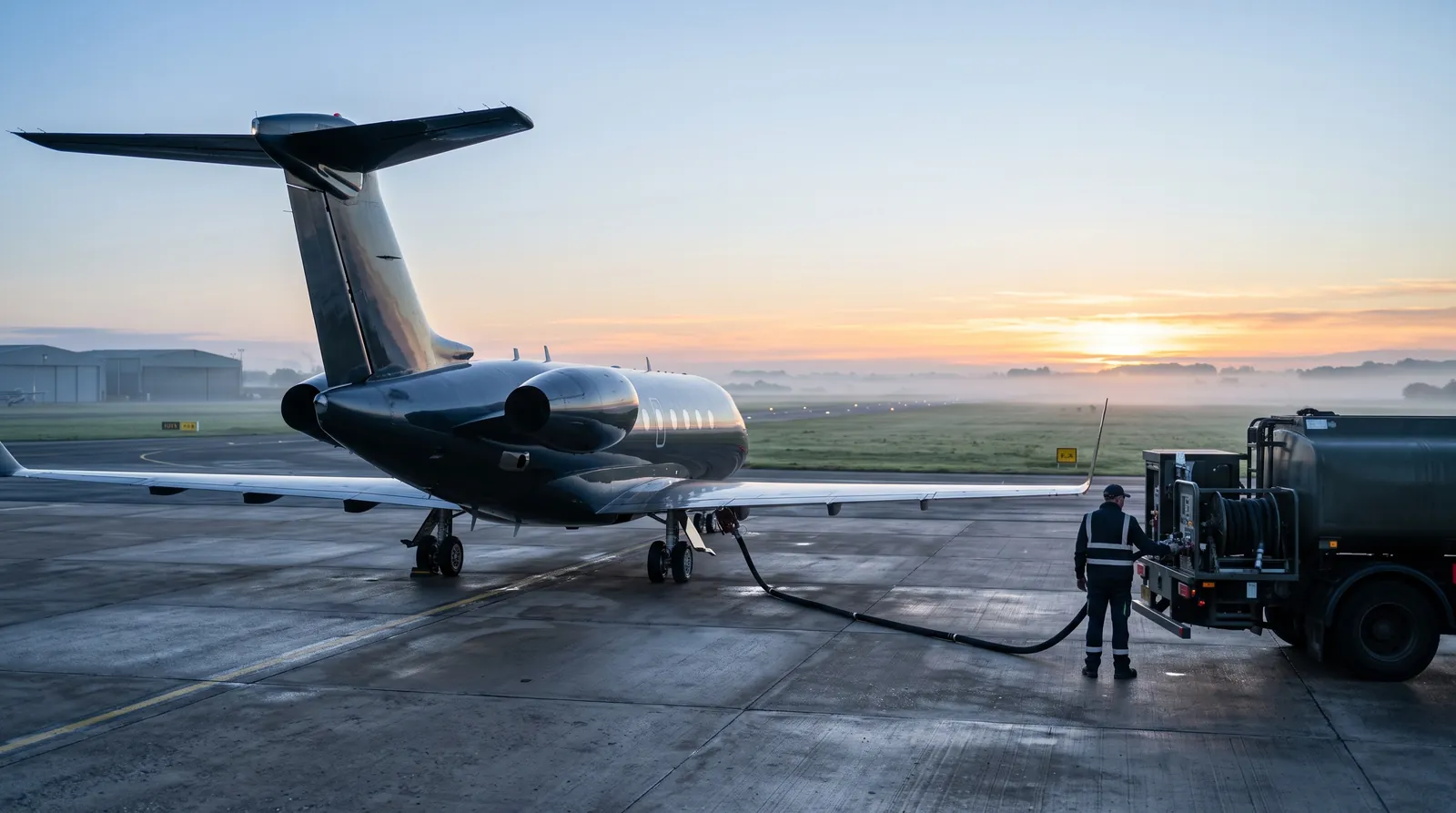
SAF is certified as a drop-in blend. Under the ASTM D7566 specification, most approved pathways may be blended with fossil jet fuel up to 50 per cent, and some only up to 10 per cent; once blended and tested, the fuel is treated as conventional Jet A-1. Demonstration flights on unblended SAF have taken place, but routine use of pure SAF is not yet certified. SAF also costs a multiple of fossil jet fuel and remains a small share of supply. Even a 50 per cent blend with an 80 per cent lifecycle saving cuts the emissions of that uplift by only about 40 per cent.
The EU mandate: ReFuelEU Aviation
Since 2025, ReFuelEU Aviation has required fuel suppliers at EU airports to deliver a minimum share of SAF, with a rising sub-target for synthetic fuel:
- 2 per cent SAF from 2025
- 6 per cent from 2030, of which synthetic fuel averages 1.2 per cent over 2030 and 2031 (at least 0.7 per cent in each year), rising to an average of 2 per cent over 2032 to 2034
- 20 per cent from 2035, including 5 per cent synthetic
- 34 per cent from 2040, including 10 per cent synthetic
- 42 per cent from 2045, including 15 per cent synthetic
- 70 per cent from 2050, including 35 per cent synthetic
The rules apply at EU airports with more than 800,000 passengers or 100,000 tonnes of freight a year. Until the end of 2034, suppliers may meet the shares as an average across all the EU airports they supply, so not every litre at every airport contains SAF. Commercial flights are in scope, including business aviation flights operated for commercial purposes, and operators above the regulation's size thresholds must uplift at least 90 per cent of the fuel they need for the year at each EU airport, to prevent tankering. Purely private flights fall outside the operator obligations unless their operator opts in, although they buy the same supplier fuel.
Book and claim, and what you are actually buying
SAF is not available at every airport, so a model called book and claim has grown up. The SAF goes into a fuel system somewhere, and the buyer receives a certificate for its environmental attributes to claim against their own flights. It is a sensible way to fund SAF production, provided the accounting is clean. Ask four questions: is the SAF additional to what the supplier must blend under the mandate anyway; is the certificate retired in a registry so it cannot be claimed twice; which feedstock and lifecycle value does it carry; and does the claim cover the full lifecycle?
Offsets and their limits
Carbon offsets fund emission reductions or removals elsewhere, from forestry and cookstoves to renewable energy and direct air capture. Their weaknesses are well documented: projects that would have happened anyway, forests that later burn, credits that overstate their effect and credits counted twice. Avoidance credits are often regarded as weaker than removal credits, which take carbon out of the air, but durable removals are scarce and expensive. An offset does not change what the flight emitted; treat it as compensation for what remains after reducing.
What actually reduces a trip's footprint
- Right-size the aircraft. The smallest jet that does the trip properly burns least; the guide to jet categories and the Aircraft Finder help.
- Avoid empty positioning. An aircraft based near your departure, or an empty leg that would fly anyway, removes empty sectors.
- Prefer newer types. Recent designs burn noticeably less than older ones of similar size.
- Fly fewer, fuller flights. Combined trips and filled seats lower the figure per person.
- Buy SAF where it can be uplifted, or through book and claim with a registry, and offset what remains with credible removals.
Questions
How much CO2 does a private jet emit per hour?
Indicatively, about 0.8 to 1.1 tonnes an hour for a very light jet, 2.4 to 3.2 tonnes for a super midsize jet and 4.4 to 5.7 tonnes for an ultra long range jet, using 3.16 kg of CO2 per kg of fuel. These are rounded averages: short sectors, heavy loads and weather push the real figure up.
What is the maximum SAF blend allowed today?
Under the ASTM D7566 specification, most approved SAF pathways can be blended with fossil jet fuel up to 50 per cent, and some only up to 10 per cent. Demonstration flights have used unblended SAF, but routine use of pure SAF is not yet certified.
Does ReFuelEU Aviation apply to private jets?
The SAF supply mandate applies to fuel suppliers at larger EU airports, so private jets refuelling there buy fuel that counts towards it. The operator obligations, such as uplifting at least 90 per cent of yearly fuel needs at each EU airport, apply to commercial flights, including commercial business aviation, above size thresholds. Purely private flights fall outside unless their operator opts in.
Are carbon offsets for private flights worth buying?
They can fund real climate projects, but quality varies widely and an offset does not change what the flight emitted. If you buy them, favour verified removal credits retired in a public registry, and treat them as the last step after choosing the right aircraft, avoiding empty sectors and using SAF where possible.
Figures checked 19 October 2026. Prices are indicative and never a quote. Seen something out of date? Tell the editors.