
ACFAircraft · Profile
HondaJet Elite II: Very Light, Very Clever
Engines mounted above the wings, 1,547 nm of range and a roomy cabin for the class: the HondaJet Elite II explained for owner-pilots and charter clients.
3 min readRolavia editors
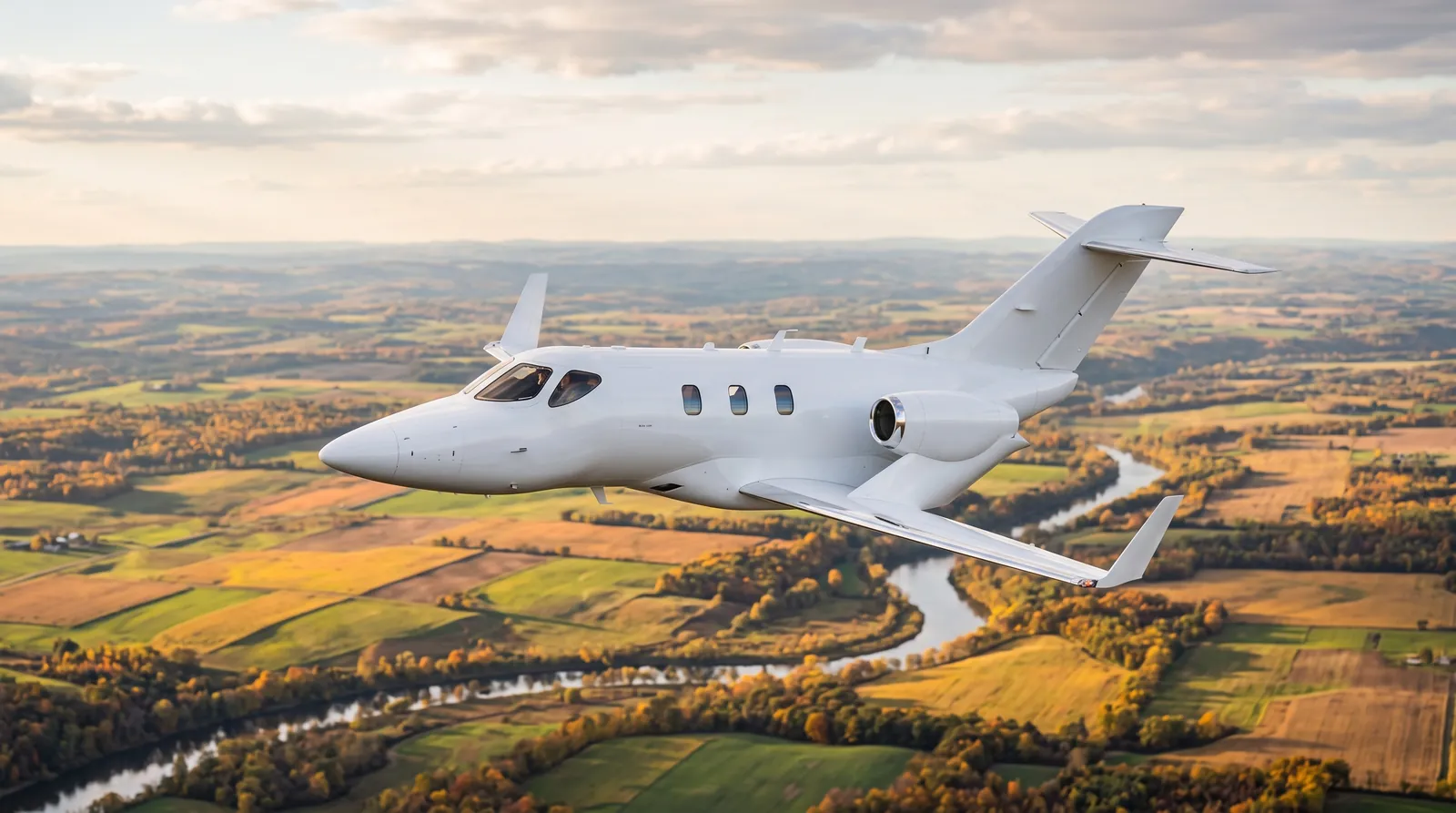
The HondaJet's signature is visible from across the ramp: its two engines sit on pylons above the wings rather than on the rear fuselage. Honda Aircraft put them there so that no engine support structure has to pass through the rear of the fuselage, which frees space for the cabin and baggage and reduces the noise and vibration reaching passengers. The current Elite II adds range, 1,547 nm with four occupants, to a very light jet flown by owner-pilots and charter operators alike.
The over-the-wing idea
Placing engines above a wing usually costs drag. Honda's engineers found a position where the engine nacelle and the wing interact favourably at cruise speed, and they published the research behind this over-the-wing engine mount, along with work on a natural laminar flow wing and nose, in aeronautical journals. Honda credits the layout with lower drag, better fuel economy and a quieter cabin. For passengers, the practical results are a cabin that is longer than the airframe size suggests and a large aft baggage compartment where other jets carry their engine mounts.
Cabin and baggage
Honda gives the cabin as 17.8 ft (5.43 m) long, 5 ft (1.52 m) wide and about 4 ft 10 in (1.47 m) high. The typical layout carries six passengers with one pilot, or five with two; an alternative layout adds one more seat. Combined stowage is 62 cu ft: 53 cu ft in the aft compartment and 9 cu ft in the nose. That is enough for four people with soft weekend bags, less so for skis or several large cases, so share the luggage list early.
Performance
Two GE Honda HF120 engines of 2,050 lb thrust each give a maximum cruise speed of 422 kt at 30,000 ft and a maximum cruise altitude of 43,000 ft. The Elite II raised the maximum takeoff weight by 200 lb to 11,100 lb, allowing more fuel and lifting NBAA IFR range with four occupants to 1,547 nm, about 110 nm more than its predecessor. New ground spoilers help on takeoff and landing at the higher weight.
Runway needs are modest but not tiny. Takeoff distance at maximum weight, sea level and ISA is 3,699 ft (1,128 m), and landing distance 2,717 ft (829 m). That is longer than the larger Phenom 300E at its maximum weight, though on short trips with partial fuel the HondaJet needs less. For true short and unpaved strips, the Pilatus PC-24 is the specialist.
| Item | Figure |
|---|---|
| Range | 1,547 nm (2,865 km), NBAA IFR reserves, 4 occupants |
| Maximum cruise speed | 422 kt (782 km/h) at 30,000 ft, ISA |
| Passengers | 6 with one pilot or 5 with two in the typical layout; 7 with one pilot in the alternative layout |
| Cabin length | 17.8 ft (5.43 m) |
| Cabin height | About 4 ft 10 in (1.47 m) |
| Cabin width | 5 ft 0 in (1.52 m) |
| Baggage volume | 62 cu ft combined (53 cu ft aft, 9 cu ft nose) |
| Takeoff distance | 3,699 ft (1,128 m), maximum weight, sea level, ISA |
| Landing distance | 2,717 ft (829 m) |
| Maximum cruise altitude | 43,000 ft |
| Engines | Two GE Honda HF120, 2,050 lb thrust each |
| Maximum takeoff weight | 11,100 lb |
| Entry into service | FAA type certification November 2022, deliveries from December 2022; first HondaJet delivered December 2015 |
Owner-flown and charter use
The HondaJet is certified for single-pilot operation, and many are flown by their owners after type rating training. The Garmin G3000 based flight deck carries much of the workload, and at its launch Honda announced an autothrottle and an emergency autoland function as later additions. In charter, the aircraft is usually booked by two to four passengers for trips of one to three hours, where its lower hourly cost against a light jet matters more than cabin height.
Some typical sectors, by great circle distance:
- Farnborough to Nice: about 560 nm.
- London Luton to Ibiza: about 780 nm.
- New York (Teterboro) to Palm Beach: about 900 nm.
- New York (Teterboro) to Miami: about 960 nm.
Beyond about 1,200 nm with a full cabin, or with plenty of luggage, a larger light jet is the better tool. For owners weighing a very light jet against shares or cards, jet card, fractional or whole aircraft compares the models, and the private jet categories shows where very light jets sit. The Range Check tool draws the Elite II's reach from any departure airport.
Questions
Why are the HondaJet's engines on top of the wings?
Honda mounted the engines on pylons above the wings so that no engine support structure has to run through the rear fuselage. That frees space for the cabin and baggage, reduces noise and vibration in the cabin and, according to Honda, lowers drag at cruise speed.
How far can the HondaJet Elite II fly?
Honda quotes an NBAA IFR range of 1,547 nm with four occupants, about 110 nm more than the previous Elite S. A higher maximum takeoff weight of 11,100 lb allows the extra fuel.
How many passengers fit in a HondaJet Elite II?
The typical layout carries six passengers with one pilot or five with two pilots. An alternative layout adds one more seat, though four passengers is the comfortable number once luggage is considered.
Can a HondaJet be flown by one pilot?
Yes, the HondaJet is certified for single-pilot operation, and many owners fly their own aircraft after type rating training. Charter operators may crew it with one or two pilots, so ask when booking.
Figures checked 19 October 2026. Prices are indicative and never a quote. Seen something out of date? Tell the editors.