
DSTDestinations · Guide
Mykonos by Private Jet: Slots, Parking and the Meltemi
Mykonos takes business jets, but summer brings slots, a 40-minute ground limit and no parking. How drop and go works, what the meltemi does and when Athens is the better gateway.
4 min readRolavia editors
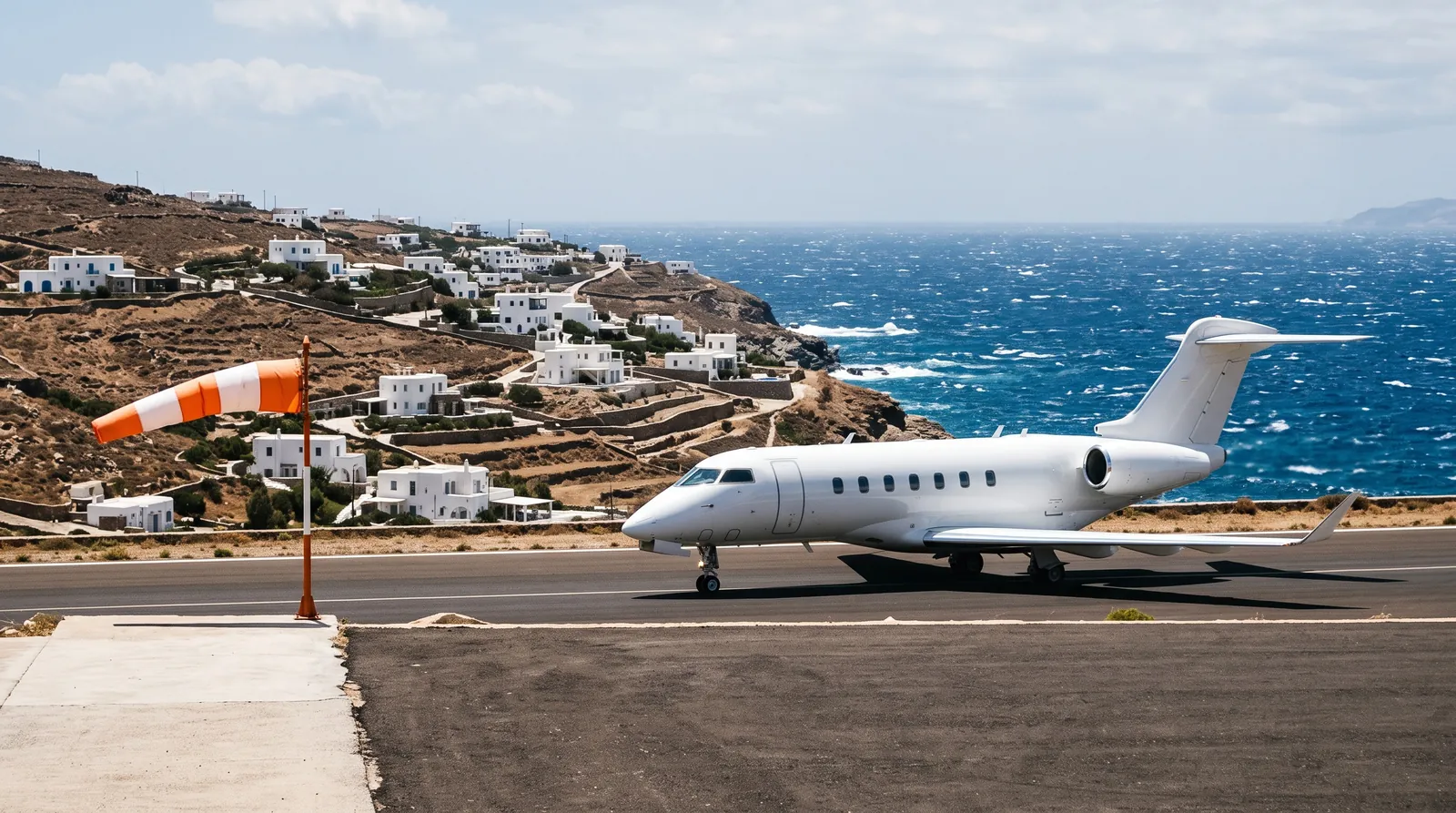
Mykonos is easy to reach by private jet and hard to stay at. The island's airport takes business jets on a 1,903 m runway only 4 km from town, but in summer it runs on slots, prior permission and a ground time limit of 40 minutes, and general aviation parking is simply not available at the peak. The usual answer is a drop and go: the jet lands, the passengers step off, and the aircraft leaves to park somewhere else. Add the meltemi, the strong northerly wind of July and August, and the schedule needs more slack than the short flight suggests.
The airport and its summer rules
Mykonos airport (LGMK) has one asphalt runway, 16/34, of 1,903 m (6,244 ft), at an elevation of 405 ft (123 m). It has been run by Fraport Greece since 2017. The runway handles jets up to large-cabin types, although its length and the summer heat make take-off performance a careful calculation for the crew on every departure.
The summer regime, published by NOTAM and usually applied from 1 May to 30 September, extended when demand stays high, sets the tone:
- Slots and prior permission are required for arrival and departure. General aviation requests open 14 days before the flight, and the tolerance is 15 minutes either way. Airline flights have priority, so general aviation slots are scarce.
- Ground time is limited to 40 minutes, and parking for general aviation is not available in peak season.
- Passengers on private flights pass through a mandatory general aviation lounge for passport, customs and security checks. Industry briefings for 2026 put the charge at €2,000 per passenger-carrying leg, or €4,000 for an arrival and a departure, plus VAT where applicable.
- Fuel uplift can be slow on busy days. Monday and Friday are usually the heaviest, Saturday often quieter.
Peak season used to mean June to September. In practice it now stretches from May through October. The guide to FBO fees explains how charges like these appear on a charter quote.
Drop and go, and where the jet waits
For most summer trips the aircraft does not stay. It repositions after the drop to an airport where parking has been confirmed, then flies back empty for the pick-up, and both positioning legs appear on the bill. Athens used to be the easy answer but no longer is: aircraft staying up to 90 minutes need no prior permission there, while longer stays do, typically processed within 24 hours of the flight. Other mainland airports and the larger islands take the overflow, and a good handler knows which have space that week. The aircraft also has to fit back into a Mykonos slot for the return, so agree the pick-up time early and change it as little as possible. The notes on the charter contract explain how positioning and waiting time are usually billed.
The meltemi
The meltemi is a dry northerly wind that blows across the Aegean in summer and is at its strongest in July and August. It tends to build through the morning, peak in the afternoon and ease after sunset, and in the Cyclades it can blow hard for several days at a time. Gusts and turbulence around the island's hills make strong days demanding for crews, and they can hold or cancel helicopter and light aircraft flights altogether. In practice:
- Morning and evening slots are usually calmer than the middle of the afternoon.
- Build in a margin for a held or diverted arrival, and keep the villa or hotel informed.
- If a helicopter connection is part of the plan, have a ferry or a fixed-wing alternative ready.
Athens plus helicopter or boat
When Mykonos is full, or when the jet should stay where it lands, Athens International (LGAV) is the natural gateway. It has two long runways of 4,000 m and 3,800 m, about 73 nm from Mykonos. From there, a helicopter to the island takes roughly 40 to 45 minutes in the air, and the fastest ferries from the port of Rafina, east of Athens, take about 2 hours 20 minutes. The helicopter transfer explainer covers weather limits and baggage, the helicopter or car tool compares door to door times, and the charter cost estimator shows what the jet sector itself is likely to cost.
Questions
Can you park a private jet at Mykonos in summer?
Generally not. In peak season general aviation parking is not available and a NOTAM limits ground time to 40 minutes, usually from May to September. Most flights are drop and go, with the aircraft repositioning to an airport where parking has been confirmed.
What is the meltemi and does it affect flights?
The meltemi is a dry, strong northerly wind over the Aegean, at its strongest in July and August and usually at its peak in the afternoon. It can cause holds, diversions and helicopter cancellations, so morning and evening slots and a fallback plan are worth having.
How do you get from Athens to Mykonos privately?
By helicopter, roughly 40 to 45 minutes in the air, or by fast ferry from Rafina in about 2 hours 20 minutes. A second option is a short jet or turboprop sector from Athens, subject to the same Mykonos slot and ground time rules.
Figures checked 19 October 2026. Prices are indicative and never a quote. Seen something out of date? Tell the editors.